
Cataract surgery is a short procedure and the patient goes home the same day. Precisely because of that, most of the talk about it revolves around what happens in the operating room, while what actually interests the patient most begins only once he steps outside: what am I allowed to do, what am I not allowed to do, for how long, and how will I know that something is wrong?
At the Vidar-Orasis Swiss Special Eye Hospital in Novi Sad we hear these questions at every check-up after the procedure. We have been working since 2010, and our team includes four university professors. That is why this text follows the order in which the questions actually come up, from the first day onwards.
The questions asked in the consulting room at almost every examination sound like this. When can I drive? When do I go back to work? May I bend down to tie my shoelaces or to pick up my grandchild? When can I take a shower and wash my hair? Can I work in the garden, go to the swimming pool, to the sauna, to the seaside? When do I get new glasses, because with the old ones I now see nothing at all? And when is the second eye operated on?
This text is an attempt to answer those questions honestly, in the order in which they arise: the first day, the first week, the first month. It is written both for the patient and for the family member who takes him home and who during the first days will be the one who remembers the drop schedule.
One thing must be clear before anything else. These are general guidelines about what recovery usually looks like. They cannot and should not replace the schedule you will receive from your own surgeon. Restrictions are set individually: they depend on how the procedure went, on the condition the eye was in beforehand, on which lens was implanted, on what the eye pressure is after the procedure and on which other illnesses you have. If anything in this text differs from what is written on your discharge letter or from what your doctor told you, your doctor's instruction takes precedence. Without exception.
And a second thing, equally important. Recovery is not a line that only goes upwards. During the first days vision often changes from hour to hour, it can be better in the morning than in the evening, or the other way round. Seeing worse one day than the day before does not necessarily mean that something is wrong, but there are signs where you do not wait and do not think it over. We will list them right away, before everything else, because they are the most important part of this text.
Signs for which you contact a doctor immediately
These signs are not part of a normal recovery. If any of them appears, do not wait for your scheduled check-up and do not assume that it will pass by tomorrow. Get in touch immediately.
- A sudden drop in vision. Not the mild blurring that comes and goes, but a noticeable and sudden worsening compared with how you saw the day before.
- Severe eye pain that does not let up. Mild discomfort and a foreign body sensation are expected. Pain that grows, that wakes you up or that does not ease off is not.
- Marked redness accompanied by discharge. Especially thick, yellowish or greenish discharge, lashes stuck together in the morning, a swollen eyelid.
- Flashes of light and a sudden shower of new floaters. Particularly if there were none before or if there are suddenly far more of them.
- A shadow or a curtain moving into the field of vision. From the side, from above or from below, as if someone were drawing a dark curtain across part of the picture.
- Sudden pronounced sensitivity to light accompanied by pain, so much that you cannot open the eye.
- Vomiting together with severe eye pain and headache.
If anything from this list appears, call 021 63 61 222. Vidar-Orasis Swiss works on weekdays until 8 pm and is closed at weekends. Outside those hours contact the nearest emergency service or an on-call eye clinic. Do not wait for Monday and do not talk yourself out of it with it is probably nothing: with these signs it is better to come unnecessarily than to come too late.
The rest of the text is about what is in fact the usual course.
Why recovery looks different from what people expect
Before we move on to days and weeks, it is useful to understand what actually happened inside the eye, because that shows why the rules look the way they do.
In modern cataract surgery the clouded natural lens is not removed in one piece. Through a very small incision at the edge of the cornea (the clear front part of the eye, which you can picture as the glass on a watch) the surgeon reaches the lens, breaks it into tiny fragments with an ultrasound probe and draws it out, while the natural clear membrane that enveloped it stays in place. An intraocular lens, an artificial lens that stays in the eye permanently, is then implanted into that membrane. This technique is called phacoemulsification and it is described in the literature as the standard method, which is a point your own doctor should confirm. You can read more about the procedure itself and about how the decision to have it is made on the cataract surgery page.
Three things follow from this description, and they explain almost all the rules of recovery.
First, there is an incision in the eye. It is small and most often not sutured, because it is made in such a way that it closes itself under the pressure of the fluid from inside. That is a great advantage for the speed of recovery, but it also means that during the first days the incision has not healed into a scar, it is only pressed together. Anything that abruptly changes the pressure inside the eye or mechanically pushes on the eyeball, while that incision is not yet firmly closed, carries a risk. Hence the ban on rubbing, the caution about bending and lifting weights, and the shield over the eye for sleeping.
Second, the eye was open. However briefly and in however sterile conditions, the inside of the eye was in contact with the outside world. That is why antibiotic drops are given after the procedure and why during the first days everything that increases exposure to dirt and micro-organisms is avoided: swimming pools, saunas, lakes, the sea, dusty work, work with soil.
Third, a controlled injury was caused inside the eye, so an inflammatory reaction follows. That is a normal biological response of the tissue, not a complication. But that reaction produces a gritty feeling, redness, mild blurring and sensitivity to light, and it has to be kept under control. That is why anti-inflammatory drops are given, and why they are not stopped on your own initiative as soon as you feel better.
When the rules are viewed through these three reasons, they stop looking like an arbitrary list of prohibitions and it becomes clearer what is probably fine in your particular situation and what is not.
The first day
The first few hours
The procedure is most often done under local anaesthesia with drops, and the patient goes home the same day. The first thing most people notice when the eye is uncovered is that the picture is brighter and that the colours are different, often markedly bluish or cooler. The reason is simple: for years the clouded lens acted as a yellowish filter through which the light had to pass. When that filter is removed, more light and a different balance of colours suddenly reach the brain. It takes a few days to a few weeks to get used to this, and it is a usual occurrence, not an error.
At the same time, the picture is most often not sharp. It is blurred, as if through fogged glass, sometimes with double contours as well. This confuses people who expected to see perfectly straight away. The blurring of the first days comes from swelling of the cornea, from the drops, from the wide pupil and from the inflammatory reaction itself, and it usually improves gradually.
The following is also to be expected: a gritty or eyelash sensation in the eye, watering, mild redness, especially at the site of the incision, sensitivity to bright light, and a feeling that the eyelid is heavy. The discomfort is usually mild and bearable.
What to do at home that day
It is usual to spend the first day quietly. Not in bed and not in a darkened room, because that helps nobody, but without strain. In practice, that means the following.
Let somebody else drive you home. Do not drive yourself that day, not even a short distance, not even along a quiet street. Vision is blurred, the pupil is wide and reactions are slowed.
Rest with your head raised, on a pillow, not lying flat. Do not lie on the side of the operated eye.
Wear sunglasses when you go outside, both that day and on the following ones. They are not there for the sake of appearance, but because sensitivity to light is pronounced during the first days, and along the way the glasses protect the eye from wind, dust and unconscious touching.
Watching television, using the phone and reading are most often not forbidden, because they do not strain the eye in a way that would harm the incision. The only problem is that reading through blurred vision is difficult, so it is better not to insist and not to get annoyed. If you do read, do it in larger print and for shorter periods.
What is avoided that day: bending the head below waist level, lifting heavier things, straining, briskly wiping the face with a towel, and of course any touching of the eye.
The first night and the shield
It is usual to sleep with a protective shield over the operated eye for the first nights, either the transparent plastic one or one with gauze, as prescribed by the clinic. The reason is not pain. In your sleep you have no control: people turn onto their stomach, bury their face in the pillow or rub themselves with a hand while asleep. The shield is there to prevent that. How many nights it is worn, and whether it is worn at all, is prescribed by your doctor.
Sleep on your back or on the side of the eye that was not operated on. If you normally sleep on your stomach, the first days will be uncomfortable, but it is worth the effort.
If discomfort wakes you during the night, pay attention to the difference between a gritty feeling, which is expected, and real pain, which is not. For mild discomfort an ordinary painkiller that you normally use is usually enough, but ask your doctor about that too before you go home.
The check-up the next day
It is usual for the first check-up to take place very soon after the procedure, often as early as the next day. At that examination the surgeon looks at how the front part of the eye appears, at the incision, at the eye pressure and at how the lens has settled, and this is usually where the drop schedule for the days ahead is specified. The exact date of that first check-up and of all the following ones is given to you by your own doctor and it takes precedence over any general schedule from a text.
Do not drive yourself to that check-up. Take somebody with you or come by public transport.
Write down in advance what you want to ask. On the first day after the procedure people forget half their questions the moment they sit down in front of the doctor. At the end of this text there is a list of questions you can take with you.
The first week
The first week is the period in which most things change and in which discipline matters most. The incision has not healed firmly yet, the drops are on their most frequent schedule, and the sensation in the eye changes from day to day.
How vision behaves
It is usual for vision to clear gradually during the first days. In some people this goes quickly, after a day or two, in others more slowly, over two to three weeks. Slower clearing does not in itself mean that something is wrong; common reasons are swelling of the cornea, a denser cataract that required more work inside the eye, or dryness of the eye.
What almost everyone notices: vision tends to vary during the day. In the morning it is often blurrier because of dryness and because the eye has been closed, so it improves after a few instillations. In the evening fatigue sets in. The picture can fog over for a few seconds and then clear when you blink, which is most often a sign of a dry tear film, not of a problem with the lens.
Rings or glare around bright light sources are often seen during the first weeks, especially in the evening. In some patients this fades as the swelling subsides. In patients with lenses that have additional optical properties, part of these phenomena lasts longer until the brain adapts, and this is discussed before the lens is chosen. We wrote separately about the differences between lenses in the text on types of lenses for cataract surgery.
The sensation in the eye
A gritty or eyelash sensation under the lid is the most common complaint of the first week. It comes from the fact that tiny nerves on the surface of the cornea have been cut and that the tear film temporarily deteriorates after the procedure. On top of that, the drops that are used can dry the surface of the eye further.
If the feeling of dryness is pronounced, many people are helped by artificial tears, but which ones and how many times a day is decided by your doctor, because they have to fit in with the other drops. If you had a dry eye even before the procedure, it will probably be more pronounced during the first weeks. Tell your doctor about all the other medicines you take, and never stop glaucoma drops on your own initiative.
Redness, most pronounced at the site of the incision, is usual and normally fades during the first or second week. Some patients develop a bright red patch on the white of the eye, like a bruise, which can look frightening but is most often harmless and clears up on its own. Even so, if it is accompanied by pain or a drop in vision, get in touch.
Hygiene, showering and washing your hair
The usual rule is that water, soap and shampoo should not get into the operated eye during the first days.
Showering is most often allowed, but with the head turned so that the water does not fall directly onto the face, or with the eyes closed and without rubbing. Bathing in a tub with the head submerged is avoided.
Washing your hair is easier than people think if it is done with the head tilted back, as in a hairdressing salon, so that the water runs backwards. Ideally somebody should help you during the first days. Bending forward over the washbasin is exactly what is avoided, both because of the water and because of the position of the head.
The face is washed with a damp wipe or towel, going around the operated eye. Do not rub, do not press, do not scrape deposits off the lashes with a fingernail. If there are small deposits in the morning, wipe them away gently with clean gauze, moving from the nose outwards.
Eye make-up, mascara and pencil are not used during the first days. Ask your doctor exactly when you may use them again.
Home, cooking, household chores
Light household chores are most often not forbidden: cooking, laying the table, light tidying. What is avoided is work that raises dust, work with strong chemicals that give off fumes and anything that requires you to be bent over with your head down.
Vacuuming, turning mattresses, carrying bags home from the shop and the like should be left to somebody else during the first days. If you live alone, this is something worth organising in advance, before the procedure, rather than improvising afterwards.
Bending and lifting weights
This is a question that is asked almost every time, because it concerns everyday life: when may I bend down?
The reason for caution is that bending the head below the level of the heart and straining increase the pressure in the venous system of the head, and with it the load on an eye in which the incision has not yet healed firmly. The same applies to lifting heavy objects, to straining on the toilet, and to strong coughing and sneezing.
The practical alternatives are simple. Instead of bending, squat with your back and head upright. Instead of lifting a load, push it or ask for help. If you are prone to constipation, sort that out in advance with food and fluids, in agreement with your doctor, because straining in the toilet is a frequent oversight. If you sneeze, sneeze with your mouth open, because that reduces the sudden spike in pressure.
How long the restriction on bending lasts and how many kilograms you may lift and from when has to be told to you by your surgeon, because that depends on the incision and on how the procedure went. Do not go by the experience of a neighbour or a relative, because those are not the same eyes nor the same procedures.
The first month
After the first week most people feel that the worst is over: the eye is less bothersome, vision is clearer, everyday life is coming back. That is exactly where the most common mistake occurs, which is that the rules are broken off earlier than they should be, because the person feels well. Healing does not end when the discomfort stops.
Walking, exercise and sport
Walking is most often recommended early, because it is good for the general condition and does not strain the eye. Lighter exercise without tilting the head and without weights usually comes in after the first days, but only with the doctor's approval. Running, the gym, cycling, yoga with positions in which the head is down, swimming and martial arts all have their own time frames and you should ask about each of them separately. Pay particular attention to yoga and pilates positions with the head below the level of the heart, because people often think that this is not straining and so do not mention it to the doctor.
The garden, the field and physical work outdoors
In our conditions this is an important question, because a large number of patients have a garden or work on a smallholding.
Working with soil combines three things that are all avoided during the first weeks at once: dust and earth containing micro-organisms, bending, and straining while digging and carrying. That is why such work is postponed for longer than office work. When you do go back to it, work with protective glasses and gloves, and do not wipe sweat off your face with the hand you have been touching the soil with.
Sun, the sea and travel
Sunglasses with ultraviolet protection are a sensible habit both before and after the procedure. After the clouded lens has been removed, a greater amount of light reaches the retina, so in bright sunshine, on snow or on water you are easily dazzled.
Swimming in the sea, in a lake and in a swimming pool belongs among the activities that are postponed, and considerably longer than showering, because it involves water that is not clean and a risk of introducing micro-organisms into an eye that is still healing. Ask your doctor for the exact time frame, and ask him before you buy a ticket, not afterwards.
Drops: the schedule and why they matter
Drops after cataract surgery are not a formality and they are not just in case. Together with not rubbing the eye, they are the most important part of what is in your hands.
What is usually prescribed and what it is for
In ophthalmology three groups of drops are usually used after this procedure, and exactly what you will receive and on what schedule is prescribed solely by your own doctor:
Antibiotic drops. The aim is to reduce the risk of infection during the period while the incision heals. They are used for a short time, on a precisely defined schedule, and are not shortened on your own initiative.
Anti-inflammatory drops. Their job is to keep under control the inflammatory reaction that is a normal consequence of the procedure. These are the drops that are most often used for the longest and that are usually tapered gradually rather than stopped abruptly. If they are stopped too early, the inflammatory reaction tends to come back, with blurring and discomfort, so the treatment drags on.
Artificial tears. They are not obligatory for everyone, but for many people they considerably ease the gritty feeling and improve the stability of the picture. If your doctor approves them, they are fitted into the intervals between the other drops.
How long each group lasts, how many times a day and by what scheme it is tapered is individual and is written in your instructions. No text on the internet, this one included, may be your source for that schedule.
The instillation technique, step by step
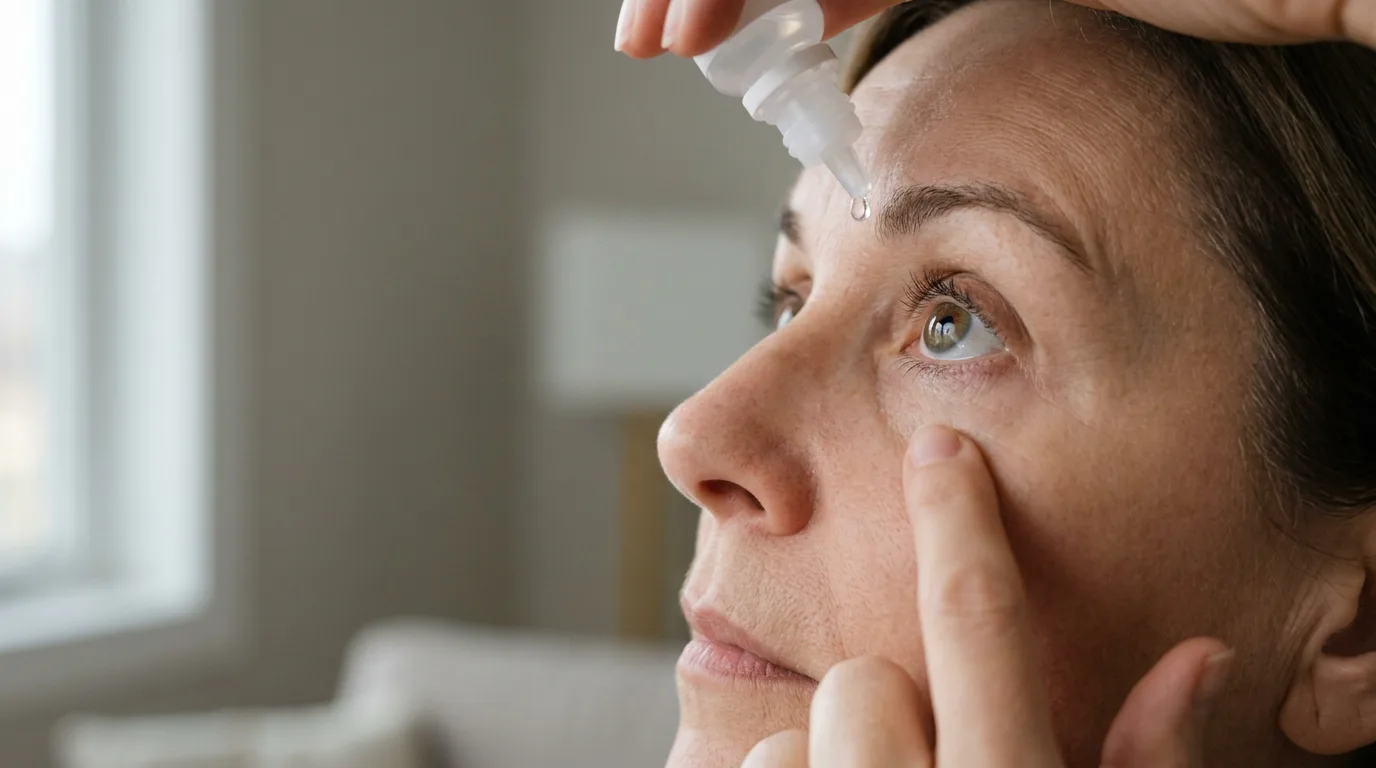
A great many people instil their drops incorrectly and therefore get less medicine than they think. Here is how it is done.
- Wash your hands with soap and water and dry them well. This is not a formality; hands are the most common route by which infection reaches the eye.
- Check the bottle. Look at the name and the expiry date, and make sure it is the right drop if you have several. Bottles are easily mixed up, especially if they look alike.
- Sit or lie down with your head tilted back. Rest your head against the back of an armchair or lie on the bed; that way you do not have to hold your head up in the air and your hand is steadier.
- With your index finger gently pull the lower lid down so that a small pocket forms between the lid and the eye. Do not press on the eyeball.
- Look upwards, towards the ceiling, and not at the bottle.
- Hold the bottle above the eye, but do not let it touch anything, not the eye, not the lashes, not your finger. The tip of the bottle must stay clean. If you touch it, you have contaminated it.
- Squeeze one drop into that pocket on the lower lid. One drop is enough. The eye physically cannot take two; the second one simply runs down your cheek and wastes your medicine.
- Close the eye gently, without squeezing and without blinking. Squeezing pushes the drop out, and blinking is a pump that carries the medicine away into the tear duct.
- Press gently with your finger on the inner corner of the eye, next to the nose, for about thirty to sixty seconds. This closes the outflow into the nose, the medicine stays on the eye for longer and less of it enters the body. This is the step almost everybody skips, and it changes the effect the most.
- If several kinds of drops are due, leave a gap between them. A few minutes are usually left between two different drops, because otherwise the second one washes out the first. Ask your doctor for the exact interval, and ointments are as a rule left for last.
- Wipe away the excess that runs down with clean gauze, without rubbing the eye.
Common mistakes with drops
Stopping as soon as it feels better. The most common mistake. How you feel is not a measure of the state of the inflammatory reaction inside the eye.
Doubling doses in order to make up for a missed one. If you miss a dose, instil it as soon as you remember and carry on with the schedule, unless you have been told otherwise. Do not double the next one.
Using somebody else's drops or old ones from the medicine cabinet at home. Never. Especially not corticosteroid drops left over from before, because in some people they raise the eye pressure and must be used under supervision.
Touching the tip of the bottle. A contaminated bottle is a source of infection.
Forgetting doses. The solution is banal and very effective: make a paper table for a week and cross off every dose you instil, or set alarms on your phone. When drops are given four or five times a day, memory fails already on the second day.
Book a check-up. Call 021 63 61 222 and arrange an appointment at the Vidar-Orasis Swiss eye hospital at Bulevar oslobodjenja 76A in Novi Sad. We work on weekdays until 8 pm. If you are not sure whether something in the eye is usual or not, a check-up is the fastest way to find out.
What is normal and what is not
This is the section for which most people look for a text like this one. The aim is for you to tell the tedious apart from the dangerous.
Usual occurrences
- A gritty, eyelash or dry sensation. The most common complaint, usually easing during the first weeks.
- Mild blurring of vision that varies during the day. Especially in the morning and in the evening.
- Redness, particularly in the area of the incision. It fades gradually.
- A bright red patch on the white of the eye resembling a bruise. Most often harmless, it clears up on its own.
- Watering.
- Sensitivity to bright light.
- Rings and glare around lights in the evening.
- The impression that colours are cooler and brighter than before.
- Mild discomfort in the eye, without real pain.
- A feeling that the new picture and the old glasses are in conflict, with dizziness and headache when you look through the old prescription.
- Tiny dark specks floating about, if there are few of them and they are not increasing.
Occurrences that call for quick contact with a doctor
- A sudden drop in vision.
- Pain that grows or does not respond to the usual painkiller.
- Marked redness with thick discharge and a swollen eyelid.
- Flashes of light and a sudden shower of floaters.
- A curtain or shadow across part of the field of vision.
- Sudden worsening after a blow to the eye or after a fall.
- A feeling that something has got into the eye and will not come out.
- Vomiting with severe eye pain.
With these signs you do not wait for the scheduled check-up. Call 021 63 61 222 during working hours, and outside them the emergency service or an on-call eye clinic.
There is also a third group, the one people most often overlook, and those are occurrences that are not urgent but need to be mentioned at the next check-up: persistent dryness that bothers you in everyday life, a feeling that vision has stalled and is not improving, double images, a marked difference in the impression between the two eyes, and the fact that you do not like something about the quality of your vision. None of that should be passed over in silence out of politeness.
Why the eye must not be rubbed
This is the rule that is broken most often, and unintentionally at that, because rubbing the eye is a reflex.
During the first days the incision in the cornea is closed by apposition, not by a scar. Pressure from a finger on the eye can mechanically open or separate it. Through even the smallest opening the inside of the eye becomes accessible from outside, and that is precisely what we guard against most in this period, because infection inside the eye is a rare but serious complication.
On top of that, rubbing most often happens precisely because the eye itches or stings from dryness. So a circle is created: dryness causes rubbing, rubbing causes irritation and even greater dryness.
Practical solutions instead of rubbing:
- Instil artificial tears if they have been approved for you; itching from dryness eases fastest with moisture.
- Wear sunglasses outdoors, because along the way they prevent you from unconsciously putting a finger in your eye.
- Wear the shield at night for as long as you have been told.
- If the urge is strong, press your palm on the cheek below the eye, not on the eye.
We wrote in a separate text about why rubbing the eyes is a bad habit outside the recovery period as well, because it is also linked with other conditions of the cornea.
Why dust, swimming pools and saunas are avoided
These three are mentioned together because they share the same root, but not the same reason.
Dust and particles. A grain of sand, grinding dust or a particle of soil that gets into the eye during the period while the incision is healing brings a double problem. First, the irritation itself and the possibility of a small injury to the surface. Second, and more important, a person reacts to it by rubbing, and rubbing hard. That is why dusty jobs are postponed, and when you go back to them, the work is done with protective glasses that fit closely at the sides.
Swimming pools, lakes, the sea and spas. Here the problem is water that is never sterile. Chlorinated water in a pool reduces the number of micro-organisms but does not remove them, and along the way it causes irritation and dryness. Lakes and hot springs are home to organisms that can cause severe infections of the cornea. An eye in which the incision has not yet healed is no place for that risk. That is why swimming is postponed considerably longer than showering, and the exact time frame is given by the doctor.
Sauna, steam room and hot steam. Here there are three things at once: a warm damp environment in which micro-organisms survive easily, sweating which leads to wiping the face with the hands, and sudden dilation of the blood vessels with a rise in pressure in the head. The same caution applies to leaning over a hot pot and to steam inhalations.
During the first weeks also avoid places with thick tobacco smoke and air-conditioned rooms in which the air blows into your face, because they worsen dryness and increase the urge to rub.
When do I go back to work and behind the wheel
Work
There is no single answer, because there is no single job. A rough division that helps in the conversation with the doctor looks like this.
Office work and work at a computer are usually resumed earliest. The restriction is most often not the eye alone: vision is blurred during the first days, so the work is tiring and slower than usual. If you are going back early, plan shorter shifts, a larger font and more frequent breaks.
Physical work, construction, agriculture, work in a workshop and everything where weights are lifted, where you bend or where particles fly about is postponed the longest and is on no account judged by how you feel.
The exact number of days for your occupation is to be requested from the surgeon, and ask for it in writing if you need it for your employer. Do not plan your return for a day on which you have a check-up scheduled.
Driving
Driving is the question people wait for most impatiently and the one on which most mistakes are made.
On the first day and to the first check-up you do not drive. That is a rule without exception.
After that, driving is allowed only once the doctor has checked your vision and made an assessment at a check-up, and once two conditions are met. The first is that the vision in that eye, together with the vision of the other eye, satisfies the requirements laid down for driving a vehicle. The second is that you yourself feel safe, without being dazzled and without double contours.
Night driving as a rule comes back later than daytime driving, because glare and rings around lights are noticed more strongly during the first weeks. Let your first outing behind the wheel be in daylight, on a familiar route, short, and if possible with somebody in the car.
If only one eye has been operated on and the other has a pronounced cataract or a large difference in prescription, judging depth and distance can be unreliable. That is one of the reasons why one does not wait too long with the second eye.
When are new glasses prescribed
Almost all patients notice straight away that their old glasses no longer suit them. That is to be expected: the prescription written into them referred to an eye with a natural lens, and now there is an artificial lens of a different power in the eye.
If your old glasses bother you, you can temporarily do without them for distance, and for reading many people find cheap ready-made glasses from the pharmacy useful during the first weeks, if the doctor approves them. That is a temporary solution, not a final one.
New glasses are not prescribed straight away. The reason is that the prescription changes after the procedure while the swelling subsides and the eye settles down, so glasses made too early would very quickly be wrong. It is usual to wait for the findings to stabilise, and in patients who are having both eyes operated on it is often necessary to wait for the second eye to be done as well, so that glasses can be made for both eyes at once. Your doctor will say at the check-up when exactly the time is right to measure the prescription in your case.
What you will see without glasses depends on which lens was implanted and on what was agreed before the procedure. A monofocal lens gives clear vision at one distance, so glasses are most often used for the other. We gave a more detailed comparison in the text on types of lenses, and the prices of examinations and of the procedure can be seen in the price list of services, with the note that prices should be checked by telephone, because they change.
When is the second eye operated on
Cataract most often develops in both eyes, though not at the same speed, which we wrote about in the text on when the right time for surgery is and in the general text on cataract.
The usual practice is for the eyes to be operated on separately, at two appointments, with an interval between them. The reasons are practical: to see how the first eye reacted, to check how closely the planned prescription was achieved and to use that experience when planning the second eye, and so that the patient always has one eye that works.
How long that interval is is determined by the clinic and the surgeon, and that is a piece of information you should get from your own doctor and not from a text. The length of the interval is influenced by the findings in the other eye, by how the first eye went and by your own commitments.
The period between the two operations can be unpleasant, and that is normal. One eye sees light and clear, the other through a yellowish haze, and the difference in prescription between the two eyes can cause headache, effort and a feeling of instability. If that bothers you a great deal, tell your doctor; sometimes a temporary adjustment of the lens in your glasses or removing the lens on the operated side helps.
Check-ups after the operation
Check-ups are not a formality. At them the eye pressure, the state of the incision, the inflammatory reaction and the way vision is returning are all monitored, and it is precisely at them that the drop schedule is changed.
It is usual for there to be several check-ups: a very early one, one during the first week, and further ones as needed over the first weeks to months. The exact schedule is given to you by your own doctor and he alone is authoritative. If you cannot keep an appointment, move it, do not skip it.
Bring to the check-up a list of all the drops you use and all the medicines you take, and write your questions down in advance. If anything changes for better or worse between two check-ups, note down when it started.
If months or years after the operation vision begins to blur again, that most often does not mean that the cataract has come back, because the implanted lens does not become cloudy. A more frequent reason is clouding of the thin membrane that holds that lens, a condition known as secondary cataract, which is dealt with by a short laser procedure.
What to ask your doctor
Take this list with you to the examination before the procedure or to the first check-up and write the answers down.
- How many days do I wear the shield and do I wear it during the day as well?
- The exact schedule of all the drops, how many days each one lasts and how it is tapered.
- What interval should I leave between different drops?
- When may I bend down and how many kilograms may I lift and from when?
- When may I shower, wash my hair and use make-up?
- When do I go back to my particular job and can I get a certificate?
- When may I drive in daylight, and when in the dark?
- When may I go to the gym, on a bicycle, to the swimming pool, to the sauna and to the seaside?
- When is the prescription measured for new glasses?
- When is the operation on the second eye planned?
- Which number do I call if something happens outside working hours?
- What exactly should worry me, in your opinion, given the state of my eye?
Book a check-up. Call 021 63 61 222 and arrange an appointment at the Vidar-Orasis Swiss eye hospital at Bulevar oslobodjenja 76A in Novi Sad. We work on weekdays until 8 pm and are closed at weekends. If you are not sure whether what you feel in your eye is part of the usual course of recovery, do not judge for yourself, but come for an examination.
Frequently asked questions
Does cataract surgery hurt and does it hurt afterwards?
The procedure is most often done under local anaesthesia with drops, so during it you mainly feel pressure and light, not pain. After the procedure mild discomfort and a gritty feeling are usual. Severe pain is not expected and because of it you contact a doctor immediately.
How many days does recovery after cataract surgery take?
Most people go through the basic part of recovery in the first weeks, while the settling of the eye and the stabilising of vision take longer, often up to a month or more. The exact time frames and restrictions for your case are given by the surgeon.
Why is my vision blurred even though the operation went well?
Blurring during the first days is usual and most often comes from swelling of the cornea, the inflammatory reaction, dryness and the effect of the drops. It is usual for it to improve gradually. A sudden drop in vision is something quite different and requires an urgent examination.
May I watch television, use the phone and read?
You may in most cases, because that does not strain the incision. During the first days it will be tiring because of the blurring and the dryness, so take breaks and do not insist.
When may I bend down?
Bending the head low and straining are avoided in the early period, and exactly how long for is said by your surgeon. Instead of bending, squat with your head upright.
May I sleep on the side of the operated eye?
It is usual to sleep on your back or on the opposite side for the first nights, with the shield on, so that the eye is not pressed and rubbed during sleep.
What if water or soap gets into my eye?
Do not rub. Rinse the eye gently with saline solution if you have it or with the drops you were given, and contact your doctor if irritation, pain, redness or a drop in vision appears.
I forgot a dose of drops, what now?
Instil it as soon as you remember and carry on with the schedule, without doubling the next dose, unless your doctor has told you otherwise. If you have missed several doses, call the clinic.
Can cataract come back after cataract surgery?
The implanted artificial lens does not become cloudy. In some patients the membrane that holds that lens becomes cloudy over time, which gives similar complaints and is dealt with by a short laser procedure.
Why this occurs, how it differs from cataract itself and how it is dealt with by laser YAG capsulotomy we explained in detail in a separate text on secondary cataract.
I see dark specks floating about, is that normal?
Many people notice small floaters more clearly than before, simply because they now see better. If a lot of new floaters appear suddenly, along with flashes of light or a shadow from the side, get in touch immediately.
Note
This text is informative in character and does not replace an examination by an ophthalmologist. All the recovery time frames stated here are general guidelines; the schedule of drops, check-ups and restrictions that you receive from your own doctor takes precedence over any text. Do not change or stop the prescribed therapy on your own initiative. The prices stated in the text are subject to change and should be checked by telephone.
Sources and further reading
The medical content was reviewed by Prof. Dr Mirko Resan. This information does not replace an eye examination or individual advice from an ophthalmologist.