
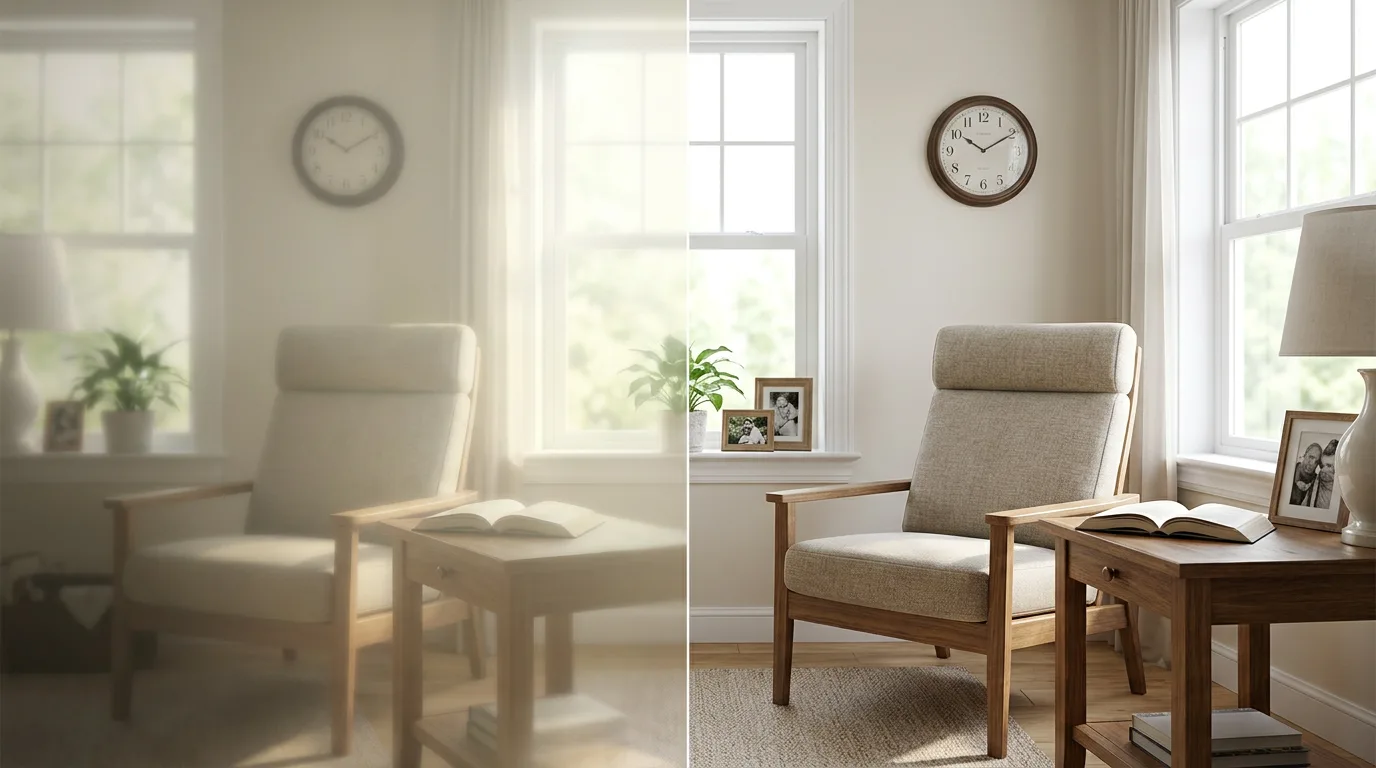
The question ophthalmologists hear most often from patients after the age of fifty goes roughly like this: "Doctor, I have some kind of fog in front of my eyes. Is that a cataract or has my prescription simply gone up?" That is a perfectly reasonable question and, honestly, it is not easy to answer it without an examination. Both conditions begin very similarly. Letters become softer (blurrier), road signs are harder to read than before, in the evening everything is somehow hazier. The difference cannot be seen from the outside, in the mirror, nor can it be felt reliably. It becomes visible only when a doctor looks inside the eye.
At the Special Eye Hospital Vidar-Orasis Swiss in Novi Sad we hear this question almost every day. The clinic has been working since 2010 and the team includes four university professors. Among them is Prof. Dr Bojan Pajic, an internationally known and recognised ophthalmic surgeon with rich clinical experience, particularly in cataract surgery, laser vision correction surgery and glaucoma surgery.
What follows is the sum of what patients ask most often and what the examination most often turns out to show.
A cataract, which we sometimes also call a clouding of the lens, is an opacification of the eye lens. The eye lens is a transparent structure the size of a bean, located behind the pupil, which together with the cornea (the transparent front part of the eye, something like the glass on a watch) refracts light and focuses the image onto the retina. When that lens stops being completely clear, light no longer passes through cleanly. It scatters. The image that reaches the retina is weaker, paler and with fewer details, even though the eye itself may be perfectly healthy on the inside.
A cataract is insidious precisely because it progresses slowly. In most people it advances so gradually that a person gets used to it before noticing it. The brain is extremely good at hiding from you a loss that arrives little by little. That is why many patients realise only after surgery on the first eye how poorly they see with the other one, because only then do they have something to compare it with.
This text was written to help you distinguish three things: what a cataract actually does to vision, which signs people most often notice first, and which other eye conditions can resemble it. We will not tell you what you have, because nobody can do that through a screen. The goal is that after reading you know exactly what to tell your doctor and why an examination should not be postponed until the fog starts bothering you at every step.
How a cataract changes vision
To understand what happens to the image, a simple comparison helps. Imagine a kitchen window through which you have been looking at the same yard for years. In the first years the glass is clean. Then, quite slowly, a thin layer of grease and dust settles on it. It does not crack, it does not go dark, no hole appears. It simply stops being transparent the way it used to be. The yard is still there, the tree is still in the same place, but details are lost, colours are greyer, and when the sun hits at an angle the whole pane lights up and you see nothing.
A clouded lens affects vision in a similar way. It does not create black spots or holes in the visual field. It reduces the quality of the whole image.
A fog that cannot be wiped away
The first and most recognisable sensation is blurring. Patients describe it in various ways: "as if I am looking through a fogged window", "as if something is drawn over my eye", "as if I constantly need to wipe my glasses". The key word is: it does not wipe away. With dry eye or with deposits on the lenses of glasses, blinking or wiping the glass improves the image for a moment. With clouding of the lens that does not help, because the obstacle is not on the outside but inside the eye.
The fog does not have to be uniform. If the clouding started at the edge of the lens, the centre of vision can stay decent for a long time, so a person notices almost nothing. If it started exactly behind the pupil, in the back part of the lens, even very slight clouding can be seriously disturbing, especially in bright light when the pupil narrows and all the light has to pass through precisely that clouded centre. Because of this a paradox occurs that confuses both the patient and the family: someone who reads reasonably well from the chart in a dimly lit room can barely recognise an acquaintance on the street at noon.
Colours that slowly fade
Clouding is not the only change. With the years the eye lens often also turns yellow. This happens so slowly that a person has nothing to compare the change with. White stops being completely white and tends towards cream or ivory. Blue and violet lose depth and move closer to grey. Telling the difference between a dark blue and a black sock becomes a struggle.
This is one of the symptoms that the family sometimes notices before the patient does. A daughter who helps a parent around the house notices that her father no longer distinguishes two similar bottles in the bathroom, or that her mother washes laundry in a way that was not usual before. In people who work with colour professionally or as a hobby, painting, sewing, dyeing, electrical work where wires are colour coded, this change can be the first serious signal.
It is interesting that after surgery many patients say that colours seem "cold" to them or even excessively blue, because for years they looked through a yellow filter and now they miss it. In most people that impression softens over time as the brain adapts.
Contrast that disappears before sharpness
This is probably the most important and the least known part of the story. Visual acuity, what we measure on the chart with letters, and contrast sensitivity are not the same thing. Contrast is the ability of the eye to distinguish an object from the background when they are not black and white but similar in brightness: a grey step on a grey floor, the edge of the pavement on a cloudy day, a thin white line on a light road, a face in semi-darkness.
With a cataract, contrast often suffers before acuity drops. That is why a situation arises that seems illogical to the patient: at the examination they read almost the whole line on the chart, and in life they trip over a threshold or do not see that water has been spilled on the table. The finding says that vision is "decent", and the person knows that something is not right. Both impressions are correct, they simply measure different things.
For that reason it is important that at the examination you describe not only how many letters you see, but also where your vision lets you down in real life. That tells the doctor more than you think.
Vision that depends on light
In a healthy eye the quality of vision is relatively stable throughout the day. In an eye with a clouded lens it becomes capricious and changes with the lighting. One person sees much better in semi-darkness than in the sun, because in semi-darkness the pupil widens and light can pass beside the central clouding. Another person, with a different distribution of clouding, functions quite decently during the day and sees almost nothing in the evening.
That unpredictability is in itself a sign worth mentioning. If you notice that the quality of your vision depends heavily on whether you are outside or inside, whether it is sunny or cloudy, whether the lamp is behind you or in front of you, that is information that should be passed on to the ophthalmologist.
Near vision that temporarily improves
There is a phenomenon that leads many to a wrong conclusion. In one type of clouding, the one that begins in the very nucleus of the lens, the lens becomes denser over time and refracts light more strongly. The consequence is a shift of the prescription towards short-sightedness. For a person who has worn reading glasses for decades this can mean that suddenly, after twenty years, they can read the newspaper again without glasses.
This can look like good news and people talk about it as a "second sight" or "vision that came back". Unfortunately, this is not a recovery. It is a change in the optics of the clouded lens, and that phase usually does not last long. Distance vision as a rule worsens in the same period. If it has happened that you suddenly no longer need your reading glasses, and you have done nothing about it, that is a reason to book an examination, not to relax.
Seven signs that people most often notice first
These are the signs that patients spontaneously describe themselves when they come for an examination. The order here is not the order of proven frequency in the literature, but of how often they are mentioned in conversation with our patients. None of them on its own is proof that you have a cataract, because each of them can also have another cause.
1. Blurred vision that does not improve with new glasses
The classic story goes like this. A person notices that they see worse, goes to an optician, gets stronger glasses and is satisfied for the first week. Then the fog comes back. After a few months they change the lenses again, and again the same. If in the last two years you have changed glasses more times than in the previous ten, and the satisfaction is short lived every time, that is one of the most useful indicators you have at all.
The reason is simple. Glasses change where the image is focused. They cannot make light pass through the clouding without scattering. If the problem is in transparency and not in focus, a stronger lens solves nothing permanently.
2. Glare in bright light
Sun hitting from the side, headlights of vehicles from the opposite direction, floodlights at a petrol station, sun reflecting off wet asphalt or off snow. With a clouded lens, light is not refracted neatly but scatters inside the eye and floods the image. Patients describe this as "it blinds me" or "everything goes white for a second".
A healthy eye also reacts to bright light, but recovers quickly. With a cataract the recovery after glare lasts longer, and during those seconds a person practically cannot see. For a driver this can be very dangerous.
3. Halos and starbursts around light sources
A street lamp that has a circle around it. A headlight that scatters into rays like a star. A traffic light that "leaks" beyond its edges. These light artefacts arise for the same reason, the scattering of light, and are most noticeable at night when the background is dark and the light source is strong.
You should know that halos around lights are not exclusively a sign of cataract. They also occur with dry eye, with pronounced astigmatism, with some corneal conditions and with a sudden rise of pressure in the eye. If halos appear suddenly together with pain in the eye, redness, nausea or headache, that is no longer a situation for postponing and we discuss it further on in this text.
4. More and more light for the same task
A person who once read with a single room lamp now switches on the floor lamp as well, and then the one on the table too. Prescriptions on medicines are read next to the window. The instructions on a box are read by stepping out onto the balcony. If the amount of light you need for the same task has noticeably increased in the last two or three years, that is a change worth mentioning.
5. Difficulty recognising faces at a distance
A face is an extremely demanding task for vision, because the differences in it are subtle and depend on contrast, not on large details. That is why it happens that a person recognises a car but not who is getting out of it. Or that on the street they recognise an acquaintance only by their walk and voice. In older people this tends to be attributed to forgetfulness, even though it is a matter of vision.
6. Double images or a shadow next to letters in one eye
Double vision is usually associated with neurological problems, and when it appears in both eyes that really is a reason for a quick check. But there is also a form that arises within the eye itself. If you cover one eye and the doubled or shadowed image still remains in the other, the cause is most often in the eye itself, in the lens or the cornea. With a cataract this is described as "a shadow next to the letters" or "a ghost of the image".
A rule worth remembering: double vision that disappears when you close one eye requires a more urgent check than double vision that remains in one eye. The first can point to a problem in the coordination of the eye muscles or in the nervous system.
7. A feeling that vision is "dirty" even though the finding is normal
This is the hardest to describe and patients often apologise while explaining it. The image is there, the sharpness is decent, but everything seems washed out, listless, like a photograph from a poor old camera. This is most often a consequence of the loss of contrast and the change in the perception of colours, and it is a legitimate symptom, not an impression that should be dismissed.
When you list these signs to the doctor, it is useful to say when it started, whether it is in one or both eyes, and whether it is getting worse. A cataract often develops in both eyes, but almost never at the same speed, so the difference between the left and the right eye is in itself an important piece of information.
Why night driving and glare are an early signal
If we had to single out one single situation in which an early cataract is most often discovered, it would be driving at night. There is a good reason for that, and it is worth understanding, because it explains why someone who has "almost normal" vision at the examination still rightly claims that their vision has weakened.
Night driving combines everything that a clouded lens tolerates worst, and all at the same time.
First, darkness widens the pupil. When the pupil is wide, light enters through a larger surface of the lens, including the peripheral parts where clouding often first appears. During the day, when the pupil is narrowed, light does not pass through that zone and that is why you do not notice it. At night it too starts to affect vision.
Second, on the road there is an extreme difference in illumination. You have complete darkness and a point of very strong light in the same visual field. A clouded lens scatters that light across the whole image, so details in the dark, which are of low contrast anyway, are completely drowned. A pedestrian in a dark jacket, a cyclist without lights, the edge of the verge, an animal on the road, all of that lives in the zone of low contrast.
Third, recovery after glare is slower. A car with strong lights passes you and you need a few seconds to see the road again. At a speed of eighty kilometres per hour, three seconds are over sixty metres of road that you have covered without a reliable image.
Fourth, at night there are no reserves. During the day an abundance of light and high contrast forgive you a great deal. At night the system works at its limit and every loss of quality is felt immediately.
That is why people typically first stop driving at night, and only after a few months or years notice that something bothers them during the day as well. When a person says "I avoid driving in the evening, I would rather wait for the morning", that is a sentence worth taking seriously, regardless of the cause. The same applies to people who work in shifts, in the field, in warehouses with mixed lighting or in construction.
For a family reading this text because of a parent: if a parent has stopped driving at night on their own, they will rarely present that as a problem with vision. More often they will say that they do not feel like going out, that they are tired in the evening or that they have nowhere to go anyway. It is worth asking directly and without pressure: "Do the headlights bother you?"
What about the driving licence
This is a worry that patients almost always have and rarely say out loud. The fear that going to the doctor will automatically mean losing the driving licence can postpone an examination for years. Two things are worth saying.
First: the criteria for a driving licence are prescribed and they are decided by medical assessment, not by your impression, nor by the impression of those around you. Second: in most people in whom the clouding of the lens is removed in time, vision weakened because of that clouding can improve to the point where the patient again performs everyday activities more easily. The final outcome depends on the state of the retina, the optic nerve and the other parts of the eye, so expectations are discussed after the examination, not before it. Nothing is gained by postponing the examination.
Why the prescription often changes
Now we come to the very heart of the question from the beginning of this text. Why does the prescription change and is a change of prescription a sign of cataract or only a sign that the years are doing their work.
The prescription changes through life for several reasons and not every change is a sign of disease.
In children and young people the eye grows and the prescription shifts with that growth. After the age of forty-five almost everyone loses the ability to focus at near. This is called presbyopia or age related long-sightedness and it is not a disease but an expected change in the elasticity of the lens. Because of it people start holding the phone further from their face and need reading glasses. That in itself has nothing to do with cataract, although it happens to the same generation and is often confused with it.
There is also a third possibility, the one that interests us here. When the lens begins to cloud, it often also changes its density, and with that the strength with which it refracts light. The result is a shift of the prescription, most often towards short-sightedness in clouding of the nucleus of the lens. With other distributions of clouding the change can also go in the other direction or astigmatism can increase.
What distinguishes an "ordinary" change of prescription from a suspicious one
Several patterns are worth keeping in mind, with the clear reservation that none of this is a diagnostic criterion but a reason for an examination.
An ordinary change of prescription is usually slow, occurs at intervals of several years, and after it you are satisfied with your new glasses. Everything improves and stays that way.
A change that deserves attention usually has a different rhythm. It happens more often than once in a year or two. The new lens helps only briefly. Other symptoms go along with it, above all glare and a drop in contrast. It happens that an eye which has been long-sighted all its life suddenly shifts towards short-sightedness. And it happens that the two eyes have set off at a different pace, so the difference between them grows.
There is also a phenomenon that is particularly worth mentioning in people with diabetes. A sudden change of prescription, which appears within a few days or weeks and tends to vary, is often connected with fluctuations of the blood sugar level, because the lens temporarily changes at high sugar values. If you have diabetes and your vision changes from week to week, that is a reason to contact both an ophthalmologist and the doctor managing your diabetes.
To be entirely honest: a change of prescription is not in itself a reliable test for cataract. It is a useful clue, nothing more. There are people with visible clouding of the lens whose prescription has not moved for years, and people whose prescription changes for entirely different reasons. You can read more about how the prescription is measured at all and what the markings on it mean on the page about refractive errors.
Why an optician cannot answer this question
Measuring the prescription and examining the eye are not the same thing. When your prescription is measured, it is established which lens gives the best image. That is valuable information, but it says nothing about what the inside of the eye looks like.
To answer the question from the beginning of this text, someone needs to look at the lens itself, and to do so with a biomicroscope, a device that magnifies the front part of the eye and illuminates it with a thin beam of light. It is often also necessary for the pupil to be widened with drops, so that the whole extent of the lens and, even more importantly, the retina behind it can be seen. Only then can it be said whether clouding exists, where it is and how pronounced it is, and, equally important, whether behind it there is some other reason for weaker vision. What such an examination includes is described on the page eye examination.
Not every cataract is the same: four basic types
In ophthalmology cataract is divided into four basic types according to why it developed. That division is useful because it explains why cataract does not occur only in older people, which is the most common misconception.
Age related cataract
The most common form and what people usually mean when they say cataract. It develops as a consequence of changes in the lens that come with the years. The proteins inside the lens change structure over time, the lens loses transparency and becomes denser. It develops slowly, as a rule in both eyes, but not necessarily at the same pace.
Age is the main factor here, but not the only one. The speed of development is also influenced by exposure to sunlight during life, smoking, some general diseases and certain medicines taken over a longer period, which is decided by the doctor who prescribed them.
Congenital cataract
A clouding of the lens with which a child is born or which appears very early. It can arise because of hereditary factors or because of the influence of harmful factors during pregnancy, including some infections. This is the reason why newborns are checked for the so called red reflex, a simple test which checks whether light passes freely through the eye.
It is important for parents to know that with children time is precious, because vision in early age is only developing and an eye that does not receive a clear image does not learn to see. If you notice a white or greyish pupil in a photograph with a flash, if the child does not follow with its gaze or if one eye deviates, that is checked without delay.
Traumatic cataract
It develops after an injury of the eye. It can appear immediately after a blow or a penetrating injury, but also months and even years later. Because of that it happens that a person connects the fog in front of the eye with something entirely different, while the cause is actually an injury from a few years ago.
If you have ever had a more serious eye injury, a blow from a ball, a branch, a tool, a chemical or sparking during welding, be sure to tell the doctor, even if you think it was long ago. This type occurs more often in one eye, which is also what distinguishes it from the age related form.
Complicated cataract
A clouding that arises as a consequence of another condition in the eye or in the body. This includes chronic inflammations inside the eye, some retinal conditions, as well as general diseases, above all diabetes. This group also includes clouding that appears after some eye operations or with long term use of certain medicines.
With this group the most important message is that the lens alone is not the whole story. If behind the clouding there is also a disease of the retina or the optic nerve, removing the clouding solves only one layer of the problem, and how much vision will improve depends on the state of those other structures. That is why before any decision about a procedure a complete examination of the eye is done, and not only an assessment of the lens.
What it looks like in everyday life
It is worth leaving textbook descriptions aside and looking at how this shows itself during an ordinary day. Patients often recognise themselves in exactly such scenes.
In the shop. The declaration on a product is printed small, usually in grey letters on a white background, therefore in low contrast, and the lighting is strong and comes from above. That is the combination a clouded lens tolerates worst. A person takes the box, turns it towards the light, and that makes the image even worse. The expiry date becomes an unpleasant everyday struggle.
Behind the wheel at dusk. The period between dusk and real darkness is the hardest part of the day. Contrast drops, and the lights are already coming on. Many patients say that this hour is the worst for them, worse even than full night.
On the stairs. A step the same colour as the floor, without an edge strip, on a cloudy day. This is a situation in which the loss of contrast turns into a real risk of falling. In older people a fall has consequences that far exceed the eye problem, and that is one of the most serious reasons why weakening of vision should not be accepted as a normal part of ageing.
In front of the television. Subtitles are white, often on a light background, and they change quickly. Patients first increase the size of the letters, then move closer to the screen, then start asking the household to read.
With grandchildren. Small toys on a colourful carpet, putting building blocks together, reading a picture book in the evening in poor light. This is one of the situations in which people admit to themselves for the first time that their vision is a problem, because the motivation is great.
At work. Working at a computer is specific because the screen itself emits light, so people with a clouded lens sometimes function better on the screen than on paper. That tends to delay recognition of the problem. On the other hand, people who work outdoors, in agriculture, construction or transport, feel the glare earlier.
Book an eye examination. If you recognise the changes described, call 021 63 61 222 and book an examination at the Vidar-Orasis Swiss clinic. We work on working days until 20:00, we do not work at weekends. An examination is the only way to establish what lies behind the fog in front of your eyes.
When it is not a cataract but something else
This is the most important part of the text and we ask you not to skip it. Clouding of the lens is not the only reason why vision weakens after the age of fifty, and some of the conditions that resemble it require a much faster reaction. With a cataract the loss of vision, once the clouding is removed, largely refers to the optical problem itself. With some other conditions the loss can be irreversible, and time can decisively influence the outcome.
What follows is not a list for self-diagnosis. On the contrary, the point of this section is to show how much these conditions overlap in symptoms and why even an experienced doctor cannot distinguish them without an examination. Many people have two conditions at the same time.
Glaucoma
Glaucoma is a group of diseases in which the fibres of the optic nerve suffer, most often, but not always, along with raised pressure inside the eye. The most common form here is insidious in a way that a cataract is not: at the beginning it does not create fog in the centre, but imperceptibly narrows the periphery of the visual field. A person reads normally for a long time and notices nothing, because the brain fills in the gaps, and the other eye covers what the first one no longer sees.
The key difference to know: damage to the optic nerve in glaucoma does not come back. Therapy aims to slow down or stop further deterioration, but what has been lost stays lost. For that reason early detection is more important in glaucoma than in cataract, even though a cataract causes more difficulties in everyday life.
There is also a rare but dramatic form, an acute attack of raised pressure in the eye, which goes with severe pain in the eye and head, redness, nausea, vomiting and a sudden drop of vision along with halos around lights. Such a condition requires an urgent examination.
Macular degeneration
The macula is the small central part of the retina responsible for sharp vision, reading and recognising faces. Its age related degeneration is one of the leading causes of loss of central vision in older people.
The symptoms overlap with cataract in that feeling of "I do not see well in the middle", but there are differences worth knowing. With diseases of the macula people often describe that straight lines appear crooked or wavy to them, that part of the text in the middle of the line is missing, or that there is a blurred or grey spot exactly in the centre of their gaze which moves together with the gaze. With a cataract the fog is as a rule uniform, without distortion and without a specific spot.
It is particularly important that a sudden drop of central vision or a sudden appearance of distortion of lines is not something that is postponed until the next free appointment. With one form of this disease the speed of reaction directly influences the outcome.
Dry eye
Dry eye is probably the most underestimated cause of fog in front of the eyes. The tear film is a thin layer of fluid that covers the cornea and represents the first optical surface of the eye. If that layer is unstable, the image blurs, but in a characteristic way: the fog comes and goes, gets worse with long looking at a screen, in air conditioned rooms, in the wind and in a heated room in winter, and after several blinks or after eye drops it improves for a while.
That is precisely the most useful difference. Vision that improves when you blink several times speaks in favour of a problem on the surface of the eye. Vision that stays the same regardless of blinking says that the cause is deeper. Dry eye can also cause glare and halos around lights, so it is easily confused with an early cataract.
Diabetic retinopathy
In people with diabetes the small blood vessels of the retina suffer over time. This can lead to leakage of fluid in the area of the macula or to other changes which for a long period give no symptoms at all.
Here the key message is unpleasant but true: serious changes in the retina in diabetes can exist while vision is still entirely good. That is why in people with diabetes an examination of the fundus is done on a schedule determined by the doctor, and not when complaints appear. People with diabetes in addition develop clouding of the lens earlier, so in them these two conditions are often found together.
An ordinary change of prescription
Finally, the most harmless possibility, and it really is common. Vision has weakened, and the reason is only that your current glasses no longer suit you. That is solved with new lenses and there is no drama in it.
The problem is that this possibility cannot be confirmed by measuring the prescription. It is confirmed by excluding everything else. If new glasses restore satisfactory vision, and the examination shows that the eye is normal on the inside, then the answer to the question from the beginning of this text really was the simpler one. That is the best possible outcome of an examination and it is worth having it in black and white.
Other conditions that can resemble it
It is worth mentioning several other causes that people do not think of. Changes on the cornea can give fog and halos. A scar or clouding on the cornea after an injury or infection changes the image similarly to the lens. Some neurological conditions and migraine give transient disturbances in vision. Some medicines affect vision. A sudden clouding along with floaters and flashes of light can point to changes in the vitreous body or on the retina.
This listing is not intended to frighten you. The goal is to make it clear why the internet cannot reliably distinguish these conditions, and an examination can.
Can an early cataract be slowed down
Patients ask this question almost always, and with hope in their voice. The answer should be given precisely, without false optimism and without unnecessary discouragement.
There are no drops or tablets for which it is reliably known that they restore transparency to an already clouded lens. What has lost transparency in the lens does not become clear again. That is why the only way for the clouding to be removed is surgically, by replacing the lens with an artificial one, and when that is decided upon is written about on the page cataract surgery.
What can be influenced is the general context. The literature lists factors connected with a faster development of clouding: smoking, long term exposure to sunlight without protection, poorly regulated diabetes and long term use of some medicines, which is decided exclusively by the doctor who prescribed them. Wearing sunglasses with protection from ultraviolet radiation, stopping smoking and orderly control of blood sugar are measures recommended for many reasons, and a possible influence on the lens is only one of them. How much they in themselves change the course in an individual is not something that can be promised.
In practice something else is more important: an early cataract does not have to be operated on immediately. In the early phase one often lives well with appropriate glasses, better lighting for reading and avoiding driving in conditions that do not suit you. Monitoring makes sense, and the decision about a procedure is made when the difficulties begin to change your way of life. When that moment is, is explained in detail in the text about when a cataract is operated on.
When to book an examination
There are situations that do not tolerate postponement and those that belong to a regular appointment. The difference matters.
Immediately, the same day: a sudden loss of vision in one or both eyes · severe pain in the eye with redness, nausea and halos around lights · a feeling of a curtain or shadow covering part of the visual field · a sudden appearance of a multitude of floaters along with flashes of light · sudden double vision · an injury of the eye. In those cases call 021 63 61 222 during working hours, and outside them contact the nearest emergency service or the eye clinic on duty.
In the coming weeks: gradual blurring that lasts for months · glare and halos that bother you while driving · a change of glasses more often than once in a year or two · loss of clarity of colours · more and more light for reading · a feeling that you see worse in one eye.
Regularly, without symptoms: after the age of forty a check-up is recommended at intervals determined by the doctor, and with diabetes, glaucoma in the family or previous eye problems even more often. Why a preventive examination makes sense even when there are no complaints is written about in more detail in the text about a preventive eye examination.
What the examination looks like and what to bring
At the examination visual acuity at distance and at near is checked, the prescription is measured, the pressure inside the eye is measured, the front part of the eye is examined with a biomicroscope and, most often with drops for widening the pupil, the fundus is examined. Drops for widening the pupil act for several hours and during that time vision is blurred and sensitive to light, so do not plan to drive yourself that day and bring sunglasses. Basic information about the disease itself can be found on the page cataract.
Bring a list of the medicines you take, your old glasses and old findings if you have them, and information about general diseases. The price of an ophthalmological examination according to the price list is 5,500 RSD, and a specialist examination by a professor 7,000 RSD. The price list changes from time to time, so check the current price by telephone before coming.
What to ask your doctor
Bring these questions written down, because in the consulting room they are easily forgotten.
- Is there clouding on my lens and how pronounced is it?
- Is my weakening of vision explained by that clouding or is there something else as well?
- What do my retina and optic nerve look like?
- Is my prescription stable compared with the previous finding?
- Can new glasses help me and for how long?
- When should I come for the next check-up?
- Am I allowed to drive, and under what conditions?
- What would be a sign for me to come earlier than the scheduled appointment?
Frequently asked questions
Can a cataract be seen with the naked eye?
With advanced clouding the pupil sometimes appears greyish or whitish, but that is a late phase. In the early phases the eye looks completely normal from the outside, so the mirror is not a usable test.
Does a cataract hurt?
A cataract itself as a rule does not cause pain. Vision weakens, but the eye does not hurt and is not red. Pain in the eye along with a drop of vision points to something else and requires a quick check.
Can a cataract lead to blindness?
In advanced cases the clouding can reduce vision so much that a person distinguishes only light and dark. Unlike damage to the optic nerve, here the cause is optical. An advanced cataract can in addition cause complications in the eye, which is one of the reasons why it is not recommended to wait indefinitely.
Does it have to be operated on as soon as it is discovered?
No. An early cataract is often monitored. The decision depends on how much it bothers you in everyday activities, on the findings in both eyes and on accompanying conditions. That is a conversation with the doctor, not a rule that applies to everyone.
What if I have a cataract in both eyes?
That is a frequent case, because an age related cataract usually develops in both eyes, but rarely at the same pace. The order and the interval between the procedures is determined by the doctor after the examination.
Will I wear glasses after the operation?
In most people the aim of the procedure is a clearer image, not freedom from glasses. A large number of patients use glasses after the procedure as well, most often for reading, depending on the type of lens implanted. The final result also depends on the state of the retina and the optic nerve, so expectations are aligned before the procedure.
Can I get a cataract again after the operation?
An implanted artificial lens does not cloud. In a number of patients the thin membrane that holds that lens becomes cloudy over time, which gives similar difficulties and is called a secondary cataract. This is resolved with a short laser procedure.
Can eye exercises, drops or diet restore the transparency of the lens?
There is no evidence that any exercise or preparation restores transparency to a clouded lens. A healthy diet and protection from the sun are useful for other reasons, but they should not be a reason for postponing an examination.
I am a daughter, and my parent refuses to go for an examination. What should I do?
It most often helps if the conversation is not conducted around the disease but around a concrete function: driving, stairs, reading prescriptions for medicines. Offer to book the appointment and to go together. An examination does not commit anyone to any procedure.
Book an eye examination. Call 021 63 61 222 and book an appointment at the Vidar-Orasis Swiss eye hospital at Bulevar oslobodjenja 76A in Novi Sad. We work on working days until 20:00. At the examination you will receive a clear answer to the question of whether it is a clouding of the lens, a change of prescription or something third.
Note
This text is of an informative character and does not replace an examination by an ophthalmologist. The symptoms described in the text can have several different causes and cannot be told apart without a clinical examination. Do not diagnose yourself and do not postpone an examination because of what you have read. The prices given in the text are taken from the price list of the Vidar-Orasis Swiss clinic and are subject to change.
Sources and further reading
The medical content was reviewed by Prof. Dr Mirko Resan. This information does not replace an eye examination or individual advice from an ophthalmologist.